Why the real estate OS struggled to scale, and what AI-native platforms change
Commercial buildings never lacked software. They lacked one shared foundation for it. That gap held back the first real estate operating systems, and AI-native platforms are built to close it.

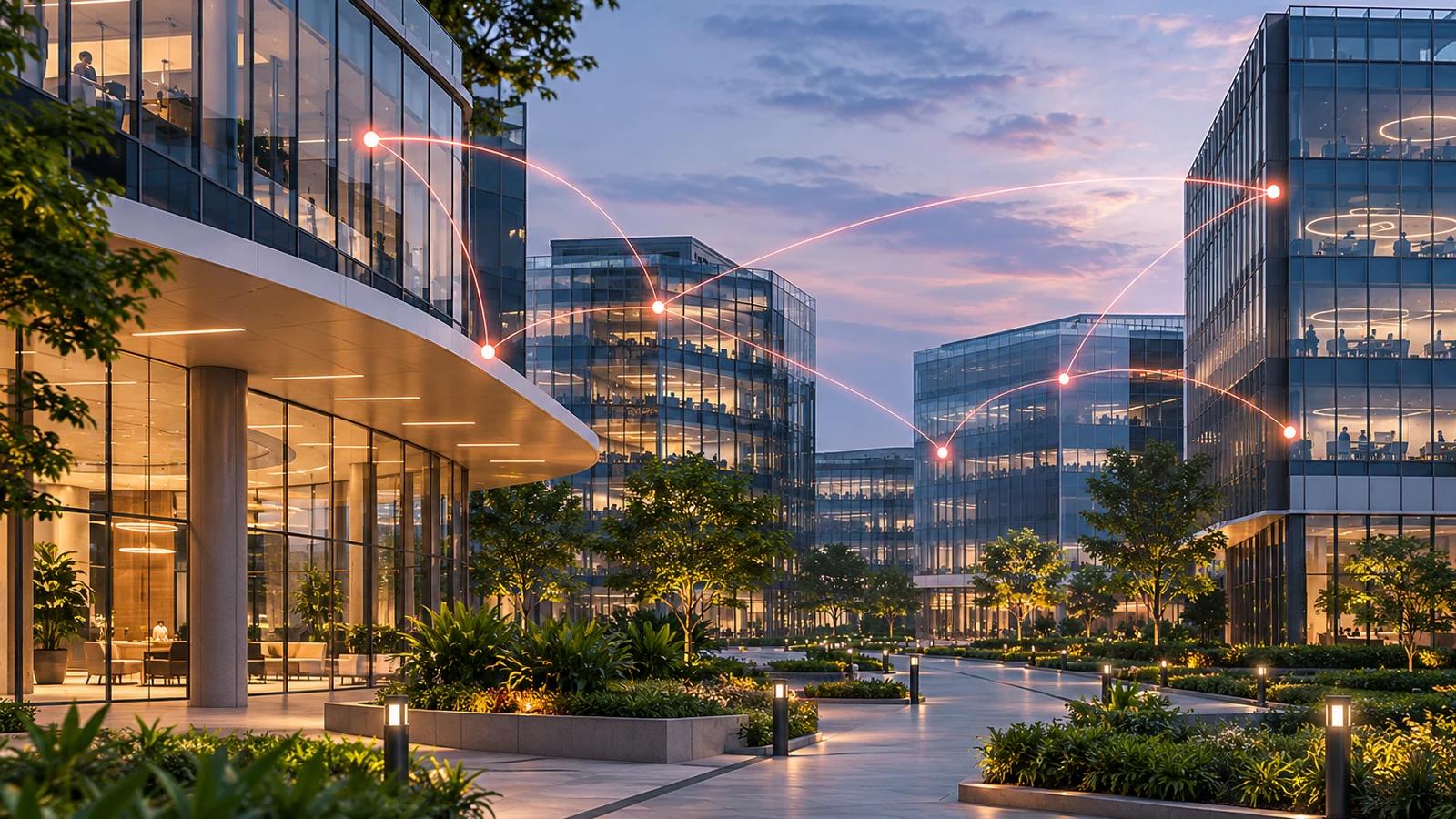
A Grade A office building already records who entered the lobby, which car used which parking bay, how the chillers are running and which complaints are open. Yet ask the asset manager what is happening across the property right now, how those events connect and what should happen next, and the answer still takes phone calls, spreadsheets and several logins.
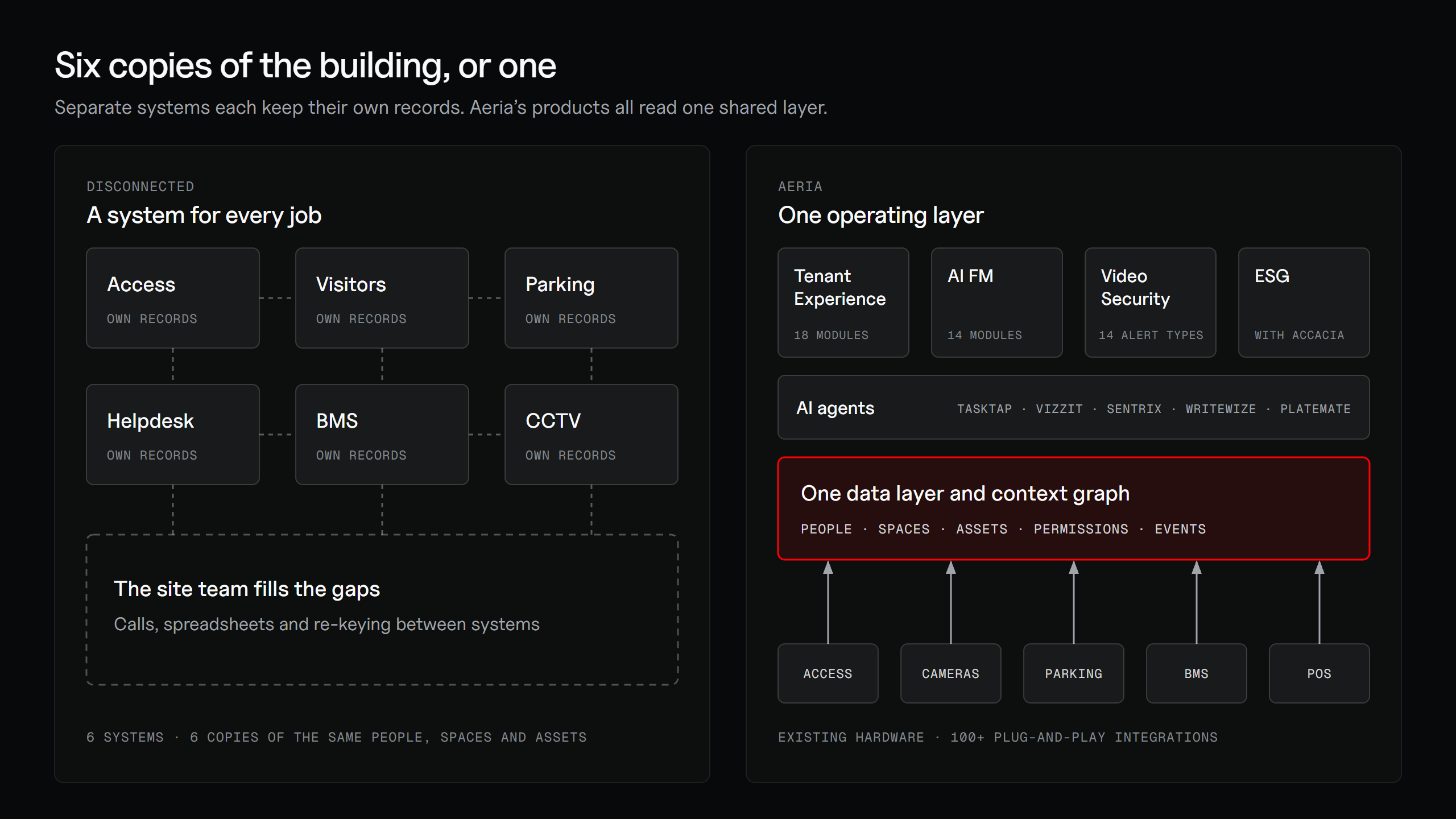
The information exists. It sits in separate systems: access control, visitor management, parking, the helpdesk, CCTV, the BMS, tenant apps and finance. Each was bought on its own, with its own records, permissions, workflows and vendor. Integrations move some data between them, but they rarely give anyone one consistent picture of the building.
The real estate operating system was meant to solve this, and the idea is a decade old. Making a whole asset run as one connected environment proved far harder than digitising its functions one by one, and AI added on top of the same fragmented stack inherits the same gaps. The opportunity now is to rebuild the operating layer around shared data, connected workflows and AI that understands the context of every decision.
Fragmentation, not a shortage of apps
The same property often holds several versions of the same tenant, employee, floor or piece of equipment. A new employee is enrolled separately for building access, parking and tenant services. A facilities supervisor checks the helpdesk, the asset register and the BMS to investigate a single complaint. A portfolio head reconciles each site’s monthly operating report in Excel.
Every system added another copy of the same people and places, and another integration to maintain. The buildings gained software, and the site teams gained more to keep in sync.
Why the first wave of real estate OS platforms stalled
Three design choices did most of the damage.
Integration was mistaken for an operating system
Connecting ten applications through APIs moves data between them. It does not reconcile their identities, asset hierarchies, permissions or names. When one system calls a floor “Tower A, Level 4” and another calls it “Block 1, Floor 03”, something still has to know they are the same place, and in most portfolios that something is a person.
Every building carried an implementation tax
Properties differ in hardware, BMS vintage, access-control vendor, operating procedures and tenant policies. A platform that depends on custom connections needs new engineering, testing and maintenance at every site, which turns a portfolio rollout into a string of one-off projects.
The economics did not hold up
A polished tenant app is hard to justify when the owner still pays for separate systems for facilities, access, parking, security and reporting. In a cost-conscious market like India, buyers weigh implementation, integrations, support, training and overlapping subscriptions, and one more app rarely moves that total.
 Open full size (opens in a new tab)
AI connects decisions when it has context
AI can read operational data, spot patterns, recommend the next action and run approved workflows across teams. To do any of that well, it needs the context around each event.
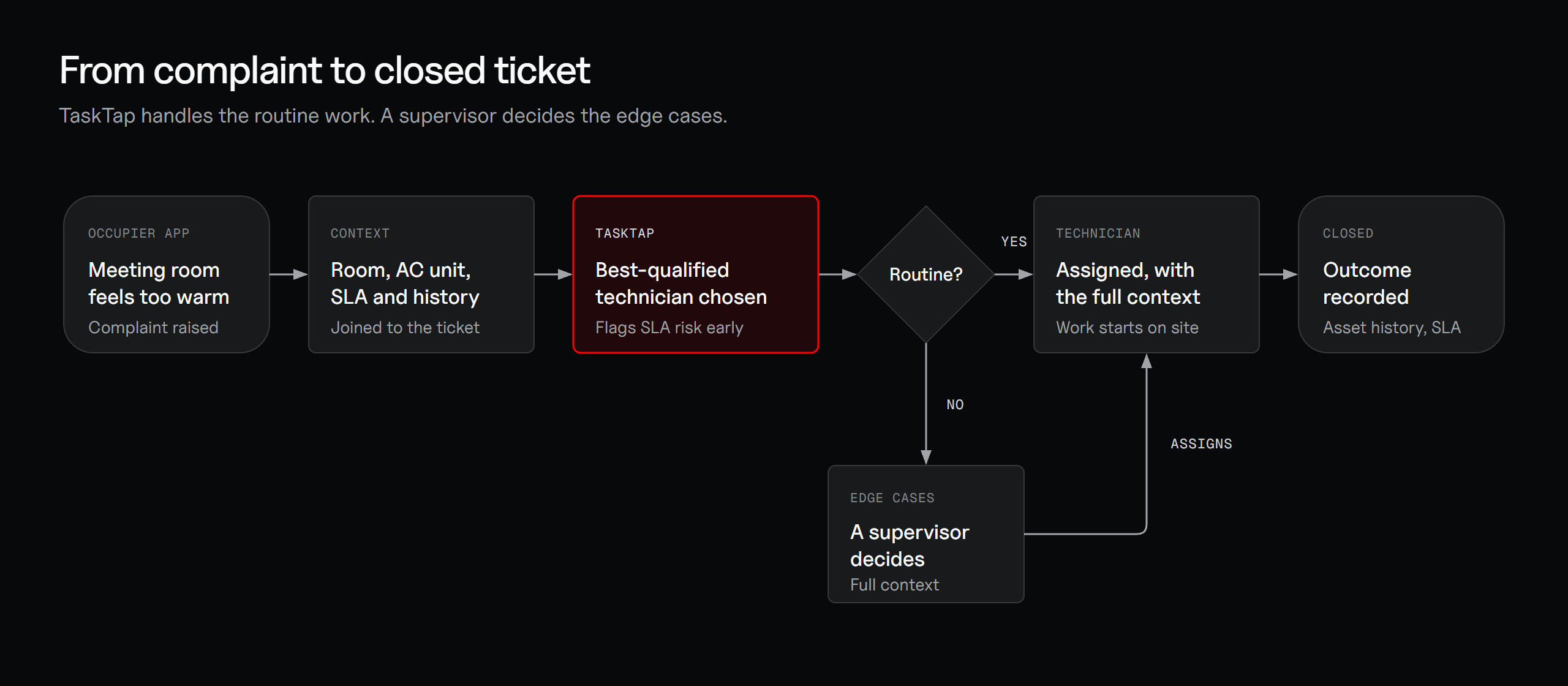
Take a common complaint: a meeting room feels too warm.
In a disconnected building, the complaint lands in a helpdesk. A supervisor then works out which AC unit serves the room, pulls its recent BMS readings, checks its maintenance history, finds an available technician and confirms the spare part is in stock. Most of the effort goes into finding information.
On a connected platform, those records arrive with the complaint. The system already knows the room, the equipment serving it, the SLA that applies and the unit’s history. AI routes the job to the best-qualified technician and flags whether the SLA is at risk. Routine work goes straight to the technician, edge cases go to a supervisor with the full context, and every step is recorded against the asset.
The gain is the right context at the moment of decision, followed by accountable action. Control of critical plant stays with people and the systems certified for it.
Context is also why AI cannot make up for weak data. In Deloitte’s 2025 commercial real estate outlook (opens in a new tab), a survey of more than 880 executives across 13 countries, only 14% of respondents said their companies had well-structured data collection and management processes alongside robust privacy policies. An AI-native platform has to build that foundation first.
 Open full size (opens in a new tab)
One shared foundation, many operational products
A scalable operating layer starts with the entities that already connect a property: buildings, floors, spaces, assets, tenants, employees, visitors, permissions and service activity.
Each of these is linked to the others. An employee belongs to a tenant. The tenant occupies particular spaces. Those spaces depend on equipment, and that equipment generates maintenance work and operating cost. When one data model holds those relationships, every module reads them instead of recreating them.
Onboarding changes as a result. A tenant or employee is registered once against a single identity, and access, parking, amenities and services each apply their own rules to it. Changes and offboarding happen in one place.
An AI-native platform keeps the building’s hardware. Cameras, access readers, parking barriers, meters and controllers are substantial investments. The practical design pairs native software where it removes duplication with reliable integrations where the hardware already exists, and feeds both into one operating model.
How Aeria is built
Aeria is built on this architecture: one data layer for the whole building, a context graph of how its people, spaces, assets and systems relate, and AI agents that act on it inside the rules each site sets. It unifies 30+ building tools into one OS and connects to the access, parking, POS, payments and IoT systems a site already runs through 100+ plug-and-play integrations.
Four live products run on that foundation:
- Tenant Experience: one app for employees and web check-in for guests, across 18 live modules for access, visitors, parking, food, amenities, events and requests. Vizzit, the visitor agent, checks in pre-approved and walk-in visitors in under 3 minutes.
- AI FM: 14 live modules for assets, maintenance, helpdesk, inspections, inventory, vendors and workforce. TaskTap routes each complaint to the best-qualified technician and flags SLA risk before a breach, working with the meters and BMS a site already has.
- AI Video Security: Sentrix watches every feed from the cameras a site already has and raises 14 types of alert, from intrusion to tailgating, with no new cameras needed.
- ESG & Sustainability, delivered with Accacia, tracking all three emission scopes for sustainability reporting.
Aeria Cloud BMS & IoT and Lease Administration are next, built on the same foundation.
Twelve interfaces, one for each role from occupier to valet driver, read from the same data. Five AI agents are live, with 20 more in development. Site teams configure workflows, approvals, forms and SOPs themselves and change them in real time.
Aeria runs across 25 office campuses, securing more than 30 million sq ft for over 100,000 users at 350+ corporates. A new site goes live in two weeks on the access, parking, POS and camera systems already in place. Support runs 24/7.
 Open full size (opens in a new tab)
Why this matters most in India
India’s office market is growing at a pace that makes repeatable operations essential. JLL reported a record 61.06 million sq ft (opens in a new tab) of gross office leasing across India’s seven largest markets from January to September 2026.
More leasing brings more occupants, more assets, more service requests and more operating data. Adding a standalone tool for every new requirement multiplies vendors, logins and copies of the same records.
One operating foundation changes the buying decision. Instead of choosing which application to add next, owners decide which workflows to run on the platform they already have.
The larger prize is asset economics: linking service requests to equipment cost, energy use to operating conditions and, with Lease Administration, leases to revenue.
What owners should ask of any real estate OS
Bringing operations onto one platform raises the bar on security and data protection. Aeria is SOC 2 Type II and ISO 27001 compliant, meets GDPR and India’s DPDPA, and is tested through VAPT. Data is encrypted in transit and at rest, and each customer’s data is kept separate.
Five questions separate an operating system from a collection of apps:
- Can a tenant be onboarded once and governed consistently across every module?
- Does a service request arrive with its asset, location and SLA already attached?
- Does the platform work with the access, CCTV, BMS and parking hardware already installed?
- Can the team see why an AI agent recommended what it did?
- Does it lower the total cost of running the building’s technology, beyond the price of one app?
The first wave of real estate technology digitised buildings one function at a time. Aeria is built for the next, where every function runs on the same context. See how the platform works or book a demo.
Sources
- Deloitte, 2025 Commercial Real Estate Outlook (opens in a new tab). Survey of more than 880 executives across 13 countries; the 14% figure.
- JLL India, India’s office gross leasing hits a record (opens in a new tab), 26 October 2026. Gross office leasing across seven markets, January to September 2026.